One of the reasons I like to read is a certain feeling that I sometimes manage to find while reading a book. I am referring to that state that you have after you receive essential information, after which you look at the same subject that you noticed yesterday, but after this book, you understand something completely different from it. It’s that feeling you have when you simply open your mind or how we say in Romania, when you come out of the dark cave and discover the sunlight.
Well, Ray Dalio has a good habit of writing books that have that effect, at least on me. In this article I will try to summarize what I understood from his book “Principles for dealing with the changing world order – Why nations succeed and fail.” The book can be ordered online from here.
I will start by admiring the dedication of the author on the front page who says: “For my grandchildren and those of their generation who will be participating in the continuation of this story: may the Force of Evolution be with you.” I admire it because it emphasizes very clearly from the beginning what the purpose of the book is, namely to prepare today’s young people to be able to build a better tomorrow. Indirectly, I felt like it was addressed to me and I hope that a good part of those who will read this article will feel the same way.
Another element for which I appreciate this book is the extraordinarily efficient way in which the information is structured. The book is made up of three parts:
In addition to this extraordinarily clear delimitation, the book can be read in a few days or a month because the essential passages have been bolded by the author and the essential principles have been marked with a red dot. In conclusion, if the 500 pages seem to be many, the book can be understood without being read page by page.
Let’s get to work, how is the Part I? Honestly, after I finished reading it, one thing came to my mind: this material should be a decisive exam subject for any politician, especially in Romania. Without knowing these elements, you should not be given decision-making power over other people.
Anyhow, what is it really about? Ray tells us how over time world empires were built, after which they fell, and were replaced by other rising empires. In this first part we are presented with the main factors that have influenced throughout history the rise of some empires, but also the stages they went through from time t0 to the top of the pyramid and back to ground level. The stages that these dominant empires have gone through remain valid for other countries, which do not necessarily dominate the world order. The same determinants act similarly in these countries. Thus, looking closely, we can understand better and better why Romania is where it is today. As the situation has shown in the last 500 years in terms of world order, you can see in the chart below.
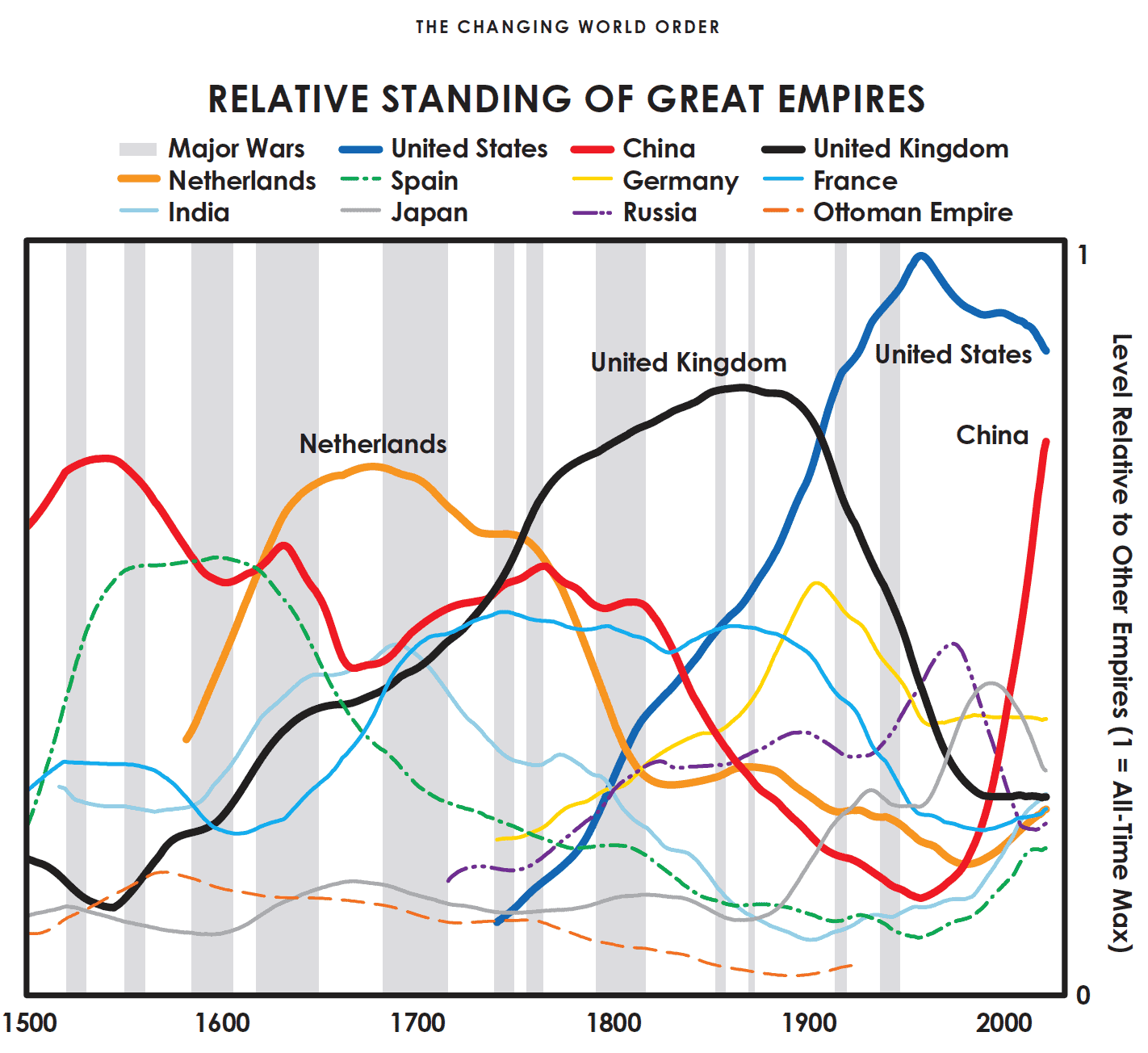
Why is there such a similarity between these empires? I mean, didn’t these people realize that history is repeating itself? Well, it’s not like that. An empire like the ones presented above reigns between 150 and 300 years. Usually those who contribute to the ascension are people who have suffered and are willing to work to build a better future, after which the next generation enjoys what the previous one has built by continuing the trend following the third or fourth generation to consider abundance as implied, which leads to excesses, which eventually lead to decline.
Now the legitimate question would be, what are the determining factors? Ray Dalio divides them into 3 categories, as follows:
The 3 decisive cycles:
The 8 determinants that define the power of a state:
Additional determinants:
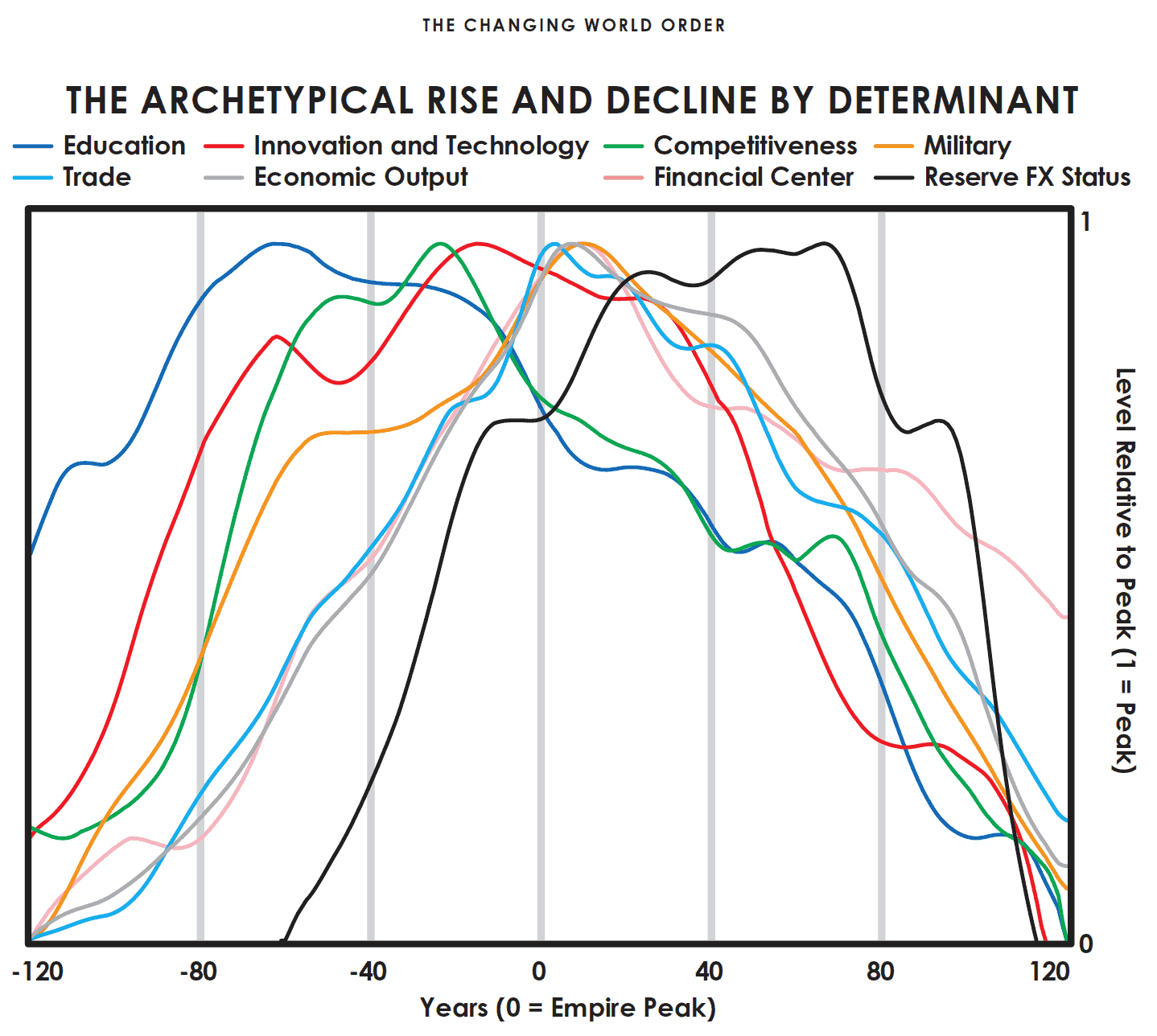
Obviously, all these factors influence each other, ultimately influencing the slower or faster evolution through the 3 important cycles. Again, looking at these determinants, I seem to understand even better where we are and what we have to do next. Further, in the graph below, we can see how these determinants evolve in a complete cycle.
Next, I think it would be interesting to present to you the 6 stages that make up the great cycle of order and internal conflict:
I will stop here with the details of the first part, and if I have aroused your interest, I invite you to discover how exactly each determinant acts and how the rest of the important cycles, the economic one but also the one of the external conflicts, are covered. Ray also explains very well the role that the Renaissance or the two Industrial Revolutions played in the dynamics of these cycles. This first chapter made me understand a little better how the world works, on a theoretical level, but the next part proved it to me.
In the second part of the book, the principles defined in the first part are reiterated through analyses aimed at the last 3 empires that dominated the world, but also the next empire that will dominate, in their name: Dutch Empire, British Empire, “Empire” of the United States of America and the future “Empire” of China. I use quotation marks because unlike the first two empires dealt with, after 1945, the mechanics of exerting influence changed, with no need for colonization. Also, because the transition between China and the United States has not yet taken place, Ray devotes a chapter to the current conflicts that the two superpowers are disputing. Here would be interesting to tell you what are the types of wars fought today:
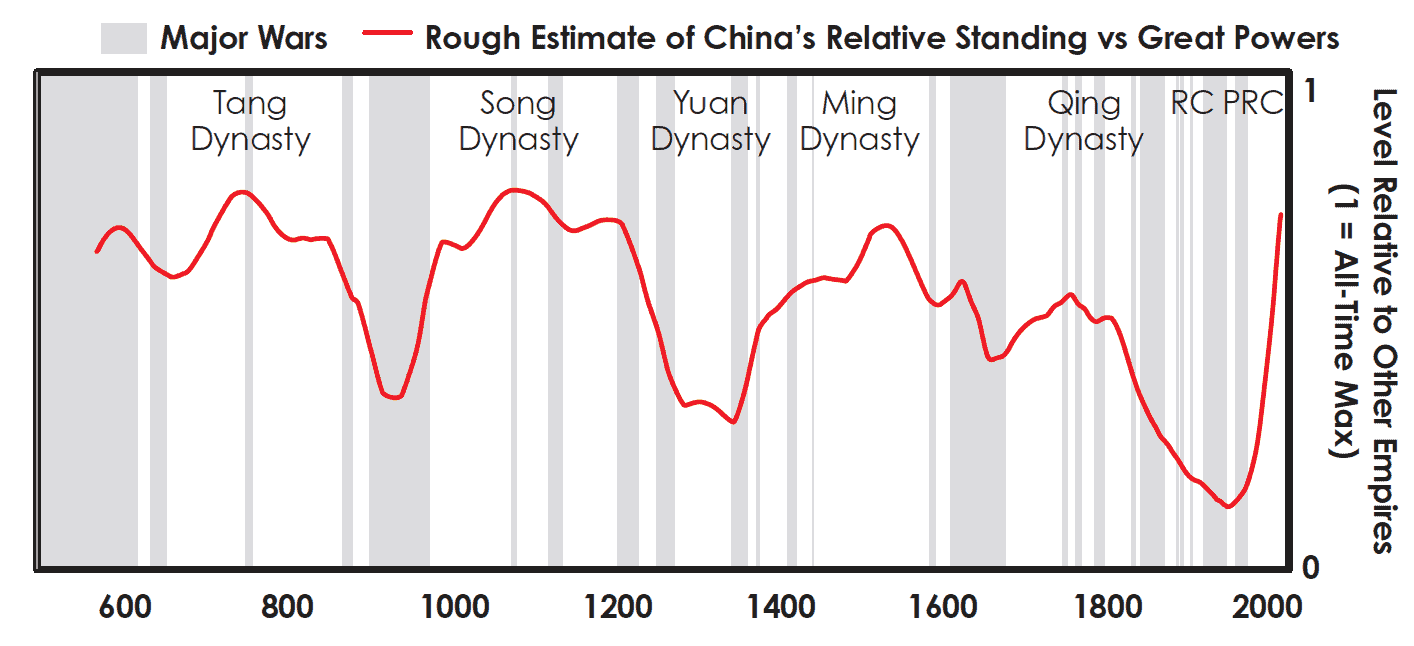
The approach that the author has in the analysis of each empire is really brilliant. In line with the concept popularized by Steve Jobs in his famous speech at Stanford University, looking back, Ray very effectively connects the dots to extract the essentials from the history of each empire. I was most fascinated by the chapter on China, a civilization of over 4,000 years that was quite often the first in the world, but which in the last 300-400 years has not found its place among the leaders, details in the chart below.
In the last part of the book, Ray Dalio gives us his opinion about the future, about how today’s position of determinants in different countries can influence the future. If you’ve gotten this far, I’ve probably made you curious, and if I’ve made you curious, I won’t say more about the third part, but I will urge you to read it yourself.
That being said, Ray Dalio remains for me one of the most lucid minds who understands macroeconomics and at the same time is able to translate it into a language that is easy to process even by someone like me. I hope you enjoy reading this book, just as I did.