I start this article by warning you, I will not only discuss the book in the tittle. I will try to describe my path to this book and why I believe that history is an elementary science for anyone who wants to be a leader, deeply understanding the peculiarities of a culture. If I were to make a technical analogy, I’m just an engineer by training, history for leaders could be thought of as the basic version of software that a given society is currently programmed with. In conclusion, it is very useful to know the programming language.
As useful as this discipline might be, it attracted me in school as little as possible. Whether it was me in some way, or maybe the history teachers I had, were more concerned with the ability of students to retain a lot of years without a deep understanding of historical contexts. I don’t want to point the finger at anyone, but of all the subjects available in school, history really has a lot of stories, and the story sells as Steve Jobs used to tell us. Where else do you think that all stories can have a demonstrative character, useful for understanding things in society. But unfortunately, at least in my time, history was treated as a memory contest emptied of content, and that’s how we may have reached a majority who sit with their hearts in their mouths when a new episode of “Love Island” appears. Maybe if future history teachers learn to communicate and market the stories of history like a Netflix series, we’ll be better as a society.
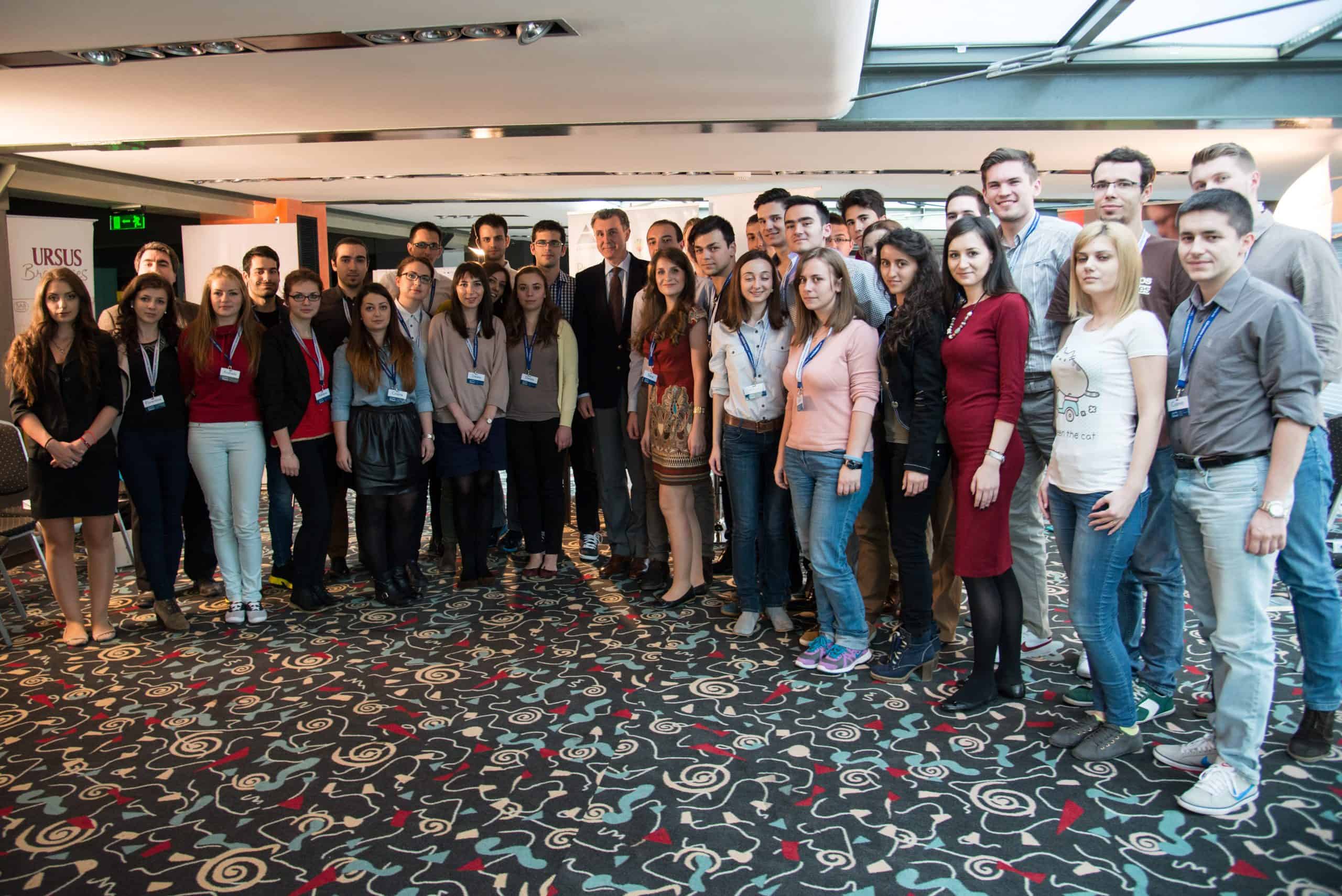
Going back, given my relationship with history, at 18 years old I don’t know much about the Royal Family. Ok, to reveal the full context, being a performance athlete in high school in a real math-physics class. I had my first contact with the Monarchy in 2014, in my first year of college, when I attended the Leaders School, where among the speakers was A.S.R. Prince Radu. I was a bit struck by the rigor with which the organizers instructed us to behave during the discussion in contrast to the relaxation shown by our interlocutor. That’s when I first started reading about the Royal Family of Romania.
Little by little, trying to make up for what I didn’t do in high school, last year around this time, being right in Sinaia, close to the Peleș Castle, I read the biography of King Carol I, the first king of the Romanians. I was shocked. First of all, I had no idea how many important things there were, and how many things a German could do for a country that couldn’t find a leader who wouldn’t steal from it. Sounds familiar? If we were to make an analogy with the modern world, Carol I was brought in to lead a start-up that was close to bankruptcy and somehow managed to obtain a much-needed independence on which to build further. Next were King Ferdinand alongside Queen Maria, who in turn, at the expense of a historical context marked by war and disease, managed to keep the historical discourse on a positive note, forming Greater Romania. Then there was an unclear period for me, with King Carol II followed by King Michael. Being a recent period though, very little exposed, at least around me. And that’s how I got to this book: Michael I – the last king of the Romanians.
The book did not last more than a week in my hands. To be honest, I think it would make a very good historical film script. The action presented in the book begins even before King Michael was born, when King Ferdinand was still on the throne. It continues with the marriage of Prince Carol II to Princess Ana of Greece, the mother of King Michael, and describes the King’s turbulent childhood in great detail. The way in which at the age of 5 he was declared King, because his father had renounced the throne to stay outside the country with another woman, then when King Carol II returned to the throne, he separated Michael from his mother, and all this time the beginning of the Second World War was being prepared.
I’m not going to reproduce the contents of the book chapter by chapter, because I’d really like you to discover it for yourself. However, after reading the two biographies, that of King Carol I and that of King Mihai, I was left with two ideas that I think are worth mentioning.
I kept thinking, what could be the role of the Royal Family in our modern society today. I look at Great Britain, Spain, Sweden and so on and notice that although kings no longer send armies to war, their moral conduct is still a benchmark for the societies they are part of. Their national identity is linked to the Royal House. Of course, in Romania this would not be a problem if we had a political class comparable as well as ethical values to a monarch. Unfortunately, this is not the case, and the political class gives the President who, unfortunately, is not exactly a role model, at least for now.
The second idea I think is worth bringing up is related to this historical inclination for political instability in the Romanian space. From the time before Carol I when the political parties could not agree on who to put at the head of the country until King Carol II who had to deal with changes of governments at a dizzying speed and until King Michael’s decision to turn the weapons against Germany in the Second World War, it seems to me that Romanian society, at least at the leadership level, has consistently failed to clearly define a set of priorities. Looking at how the last 150 years have played out and comparing it to what we have today, it all seems normal, I’d even dare to say we’ve progressed. Of course, now we compare ourselves to other states that have benefited from a completely different sequence of historical events in the last 150 years, and we are obviously unhappy.
In any case, today, more than 150 years ago, the solution to the problem lies with us, with me and you, and it is based on how we choose to define our priorities. When we are able to align on a clear set of priorities as a nation, then the political class will also be purged or at least do more of the right thing. As long as we allow ourselves to be manipulated and pitted against each other, the 150 years will repeat themselves. Here perhaps the Monarchy could have played a role.
The book can be bought from here only in Romanian: https://carturesti.ro/carte/mihai-i-ultimul-rege-al-romanilor-763565670